


Noillirk Wants One Burst of Typing and Then Your Nerve
Noillirk is a daily survey game: ten open questions, no multiple choice, and a keyboard. Each prompt asks you to name something, and being right is not the point. Being ordinary is. Answers are ranked against a pre-built sheet of what a hundred people would most likely say, and the closer yours sits to the top of that sheet, the more it pays.
That inversion is why the game earns a look on a site built around driving. There is no throttle and nothing to steer, so the feedback loop shrinks to your own confidence: you type, you commit, and then you learn whether your first instinct was shared by everyone or by nobody. What it has in common with a stunt driving game is the shape of the risk. One input, no undo, and a result you have to read before you can decide whether you were good or merely lucky.
Typing, Enter and Pass: Every Input Noillirk Has
Typing is the input, Enter is the commitment, and that is the entire control scheme. The official rules add three small things around it: an arrow button beside the box for players who would rather click, Pass to skip a prompt you cannot answer, and a tap on the scene or the Tap to skip label to hurry the reveal along.
There are no movement keys at all. All twenty-six script bundles on the site were read and none of them bind WASD or the arrows, which suits a game where the little figure only climbs when the score goes up.
- Enter submits. A word that is not on the answer sheet comes back as Not on our list, and the clock keeps running.
- The arrow button submits the same answer, for mouse players and for phone keyboards where the key reads Go.
- Pass ends the question on zero. It never subtracts from points already banked.
- Tapping the scene skips the reveal animation, and a small Next control moves on.
- Switching to another tab pauses the clock, so the thirty seconds are only spent while you are watching.
Noillirk Screens: An Empty Answer Bar, the Climb, and the Reveal
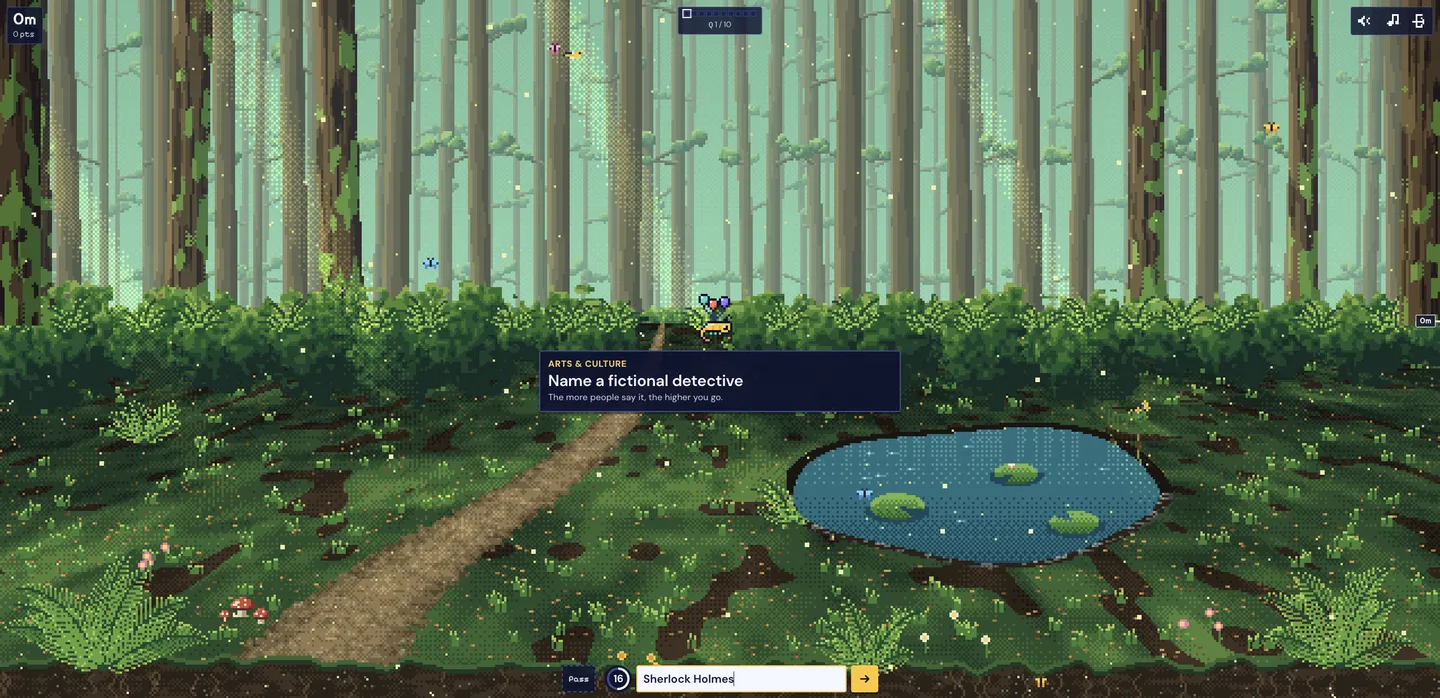
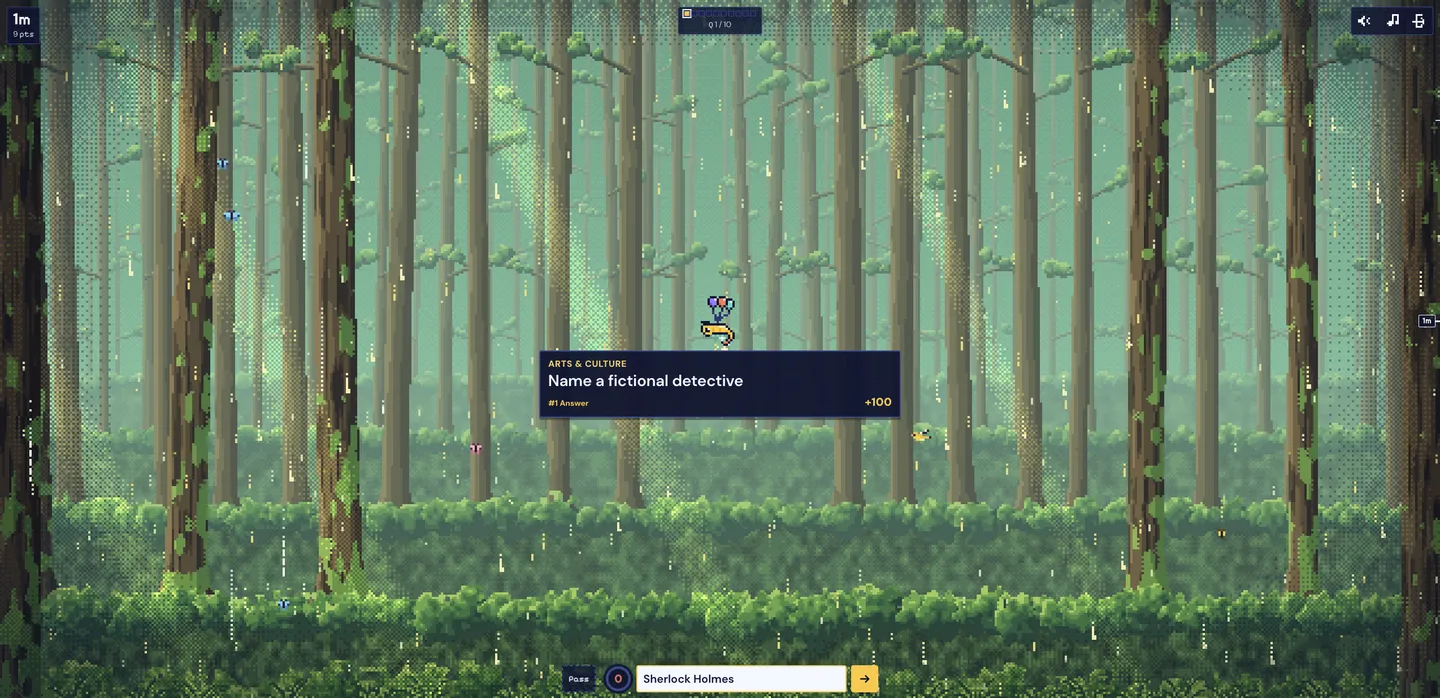
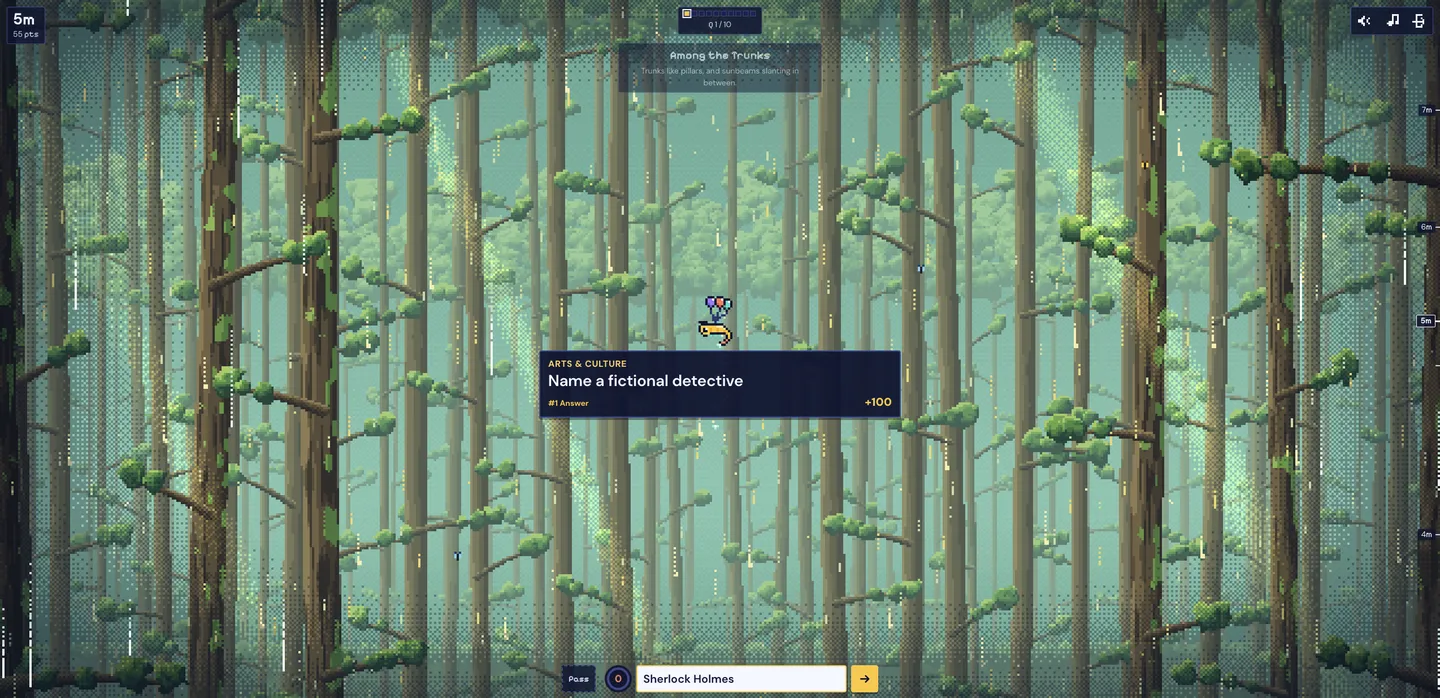
The Answer Sheet Is More Forgiving Than the Scoring
Typing an answer is the easy half, and spelling is not the part that decides anything. Case, accents and punctuation are ignored, a leading the, a or an is dropped, plurals count as singular, and common aliases pass, so Lisboa is accepted for Lisbon. Answers of five characters or more get one mistake forgiven, whether that is a missing letter, an extra one, two letters swapped or a plain typo, and the result card tells you which reading it used. Anything shorter has to be exact, which is why Rom will not pass for Rome. Rejected answers get a way out, too: the result card carries a Should this count link that sends the prompt and the answer in for review, and the site says those reports are counted without identifying details.
Forgiving input, unforgiving scoring. A valid answer that lands outside the top ten still pays only 10 points, and the sheet that decides your tier is written in advance rather than built from today's players. Being accepted and being rewarded are two different questions, and the game answers them separately, which is the single most useful thing to understand before your first daily run.
What a Wrong Answer Costs: Ten Points and Some Seconds
Nothing is deducted. A rejected answer costs the seconds spent typing it, and the timer keeps moving while the message sits there, so the punishment is time rather than score. Pass, an empty box and a timeout all score zero for that question and take nothing away from what you already have.
The real cost is the tier. Ten points instead of a hundred is the difference between pulling nobody from the crowd and pulling four people, because the conversion runs at one spectator per 25 points. On the late questions the gap widens. Weights run at ×1 for questions one and two, ×2 for three to five, ×3 for six to eight and ×4 for nine and ten, so the same weak answer that cost you 90 points early costs 360 at the end.
That weighting is the best decision in the design. It keeps the opening two questions cheap enough to gamble on and makes the closing pair feel like a different sport. A flat ten-question quiz would have spread the tension evenly and taught you nothing about when to be careful.
The Crowd Is the Scoreboard You Can Actually See
A hundred wooden spectators stand on your side of the table when a Daily begins. Every 25 points pulls one of them across to your platform, and they stay there until the round ends, so a perfect 2,500 moves all hundred. On the climb stage the same number is drawn as height: the camera rises with your score while a ruler on the right counts the metres.
This is the part that makes the feedback legible. A number going from 55 to 180 is abstract; a person walking over to your side is not, and the frame spends its animation budget on exactly that. My judgment is that the climb stage reads better for a first session, because height gives you a running sense of the round without opening any panel, while the tabletop view asks you to watch a crowd instead of a line.
Daily Is One Shot, Unlimited Is the Practice Room
The daily set is ten questions, identical for every player, thirty seconds each, numbered from the first one on 15 October 2026. There is one attempt. Closing the tab mid-round keeps your progress and the resume card picks you up at the question you left, but the shot itself does not come back until midnight.
Unlimited takes the ceiling off: ten, twenty or an endless run from the same 200-question bank, with the first ten ordered from easiest to hardest. Ten and twenty question runs replay exactly and can be turned into challenge links, which is the feature that turns a solo quiz into something you can send to a friend. The streak counter only counts completed dailies, though, so practice stays practice.
Read that as the game telling you where the stakes are. One run a day is the only one that counts, and that scarcity is doing most of the work that a difficulty setting would otherwise do.
Noillirk FAQ
Is Noillirk free?
Yes. No download, no account, no paywall and no purchase step, and no ad script was found in the page or in any of the bundles it loads.
How do you play Noillirk?
Type an answer and press Enter, or click the arrow beside the box. Press Pass if a prompt beats you, and tap the scene to skip the reveal. There are no movement keys.
How is the score calculated?
A first-place answer pays 100, second and third pay 75, fourth and fifth 50, sixth to tenth 25, and a valid answer off the board 10. Question weights then multiply that by 1, 2, 3 or 4 depending on position, and every 25 points pulls one spectator.
What is the difference between Daily and Unlimited?
Daily is ten questions once a day, the same for everyone, and it is the only mode that extends your streak. Unlimited lets you pick ten, twenty or endless from the same bank and does not affect the streak.
Why was my answer rejected?
Each question has a pre-written list of acceptable answers that is longer than the visible board but cannot cover everything. Common spellings, plurals and aliases pass, and answers of five characters or more forgive one slip. A rejection costs time, not points.
Is this the same Noillirk as the one on playdaily.org?
No. That version gives fifteen seconds a question and scores by balloon height. This one runs ten questions, thirty seconds each, with tier scoring and a hundred-person crowd, and its terms state it is independent of Daily Games.
Games on This Site That Reward One Clean Commitment
Nothing else here asks you to type. The closest thing is a game where one press has to be right the first time and there is no second attempt.


