


2 Min Drill Replaces the Controller With a Decision
The first thing to notice about 2 Min Drill is what your hands are not doing. Nobody steers, nobody sprints, and there is no stick to hold. What the game gives you instead is a real NFL two-minute drive: a score, a clock, a down and a distance, a spot on the field, a timeout count, and the twenty-two players who were on the field that day. You coach one side and call plays until the drive is over.
The clicking is small. Pick a play family, pick a call, pick a target, hit Snap. What the game asks you to feel is not weight or grip but consequence. The grade is already fixed when the ball is snapped, because the model has simulated the rest of the game for every call you could have made and then compares your choice against the best of them. For a reader who plays driving games for the response, this is the same loop with the throttle swapped for a read.
Nine Number Keys and the Space Bar in 2 Min Drill
Mouse and touch are the intended controls, and the keyboard is a shortcut layer bolted on top. Numbered buttons across the play board take 1 through 9, Space skips the snap animation, and Tab and Enter move between buttons and confirm. There is no movement input, and that absence is the whole design: nobody on the field is yours to steer, the players run the call you picked, and the result is drawn from a real one.
- 1 to 9 fire the numbered buttons on the current screen. On the target list, 1 commits the snap.
- Space cuts the play animation, which matters once a drive runs long.
- Tab and Enter walk the interface, so a keyboard-only session works.
- Nothing rebinds, and with nine keys the omission is easy to live with.
The Grade Is the Only Feedback, and It Judges the Call
Every option on the board is simulated forward from the same spot, hundreds to thousands of times, and each one gets a win probability. Your call is then scored on how far it sat from the best. Green means you found it or came within half a point of it, yellow is inside two points, orange inside five, and red is everything worse than that.
The part that changes how the game feels is what the grade ignores. A great call that was dropped stays green. A terrible call that happened to work stays red. The number beside a play is the swing in win probability in percentage points rather than the yardage, so a four-yard completion on third and two can beat a forty-yard throw that stopped the clock at the wrong moment.
That is a hard thing to build and a harder thing to teach. Most sports games grade the outcome and let you feel clever. This one tells you when you were lucky, which is the useful version and the less flattering one, and it is the reason a losing drive can still feel like good work.
2 Min Drill Screens: The Read, the Targets and the Result
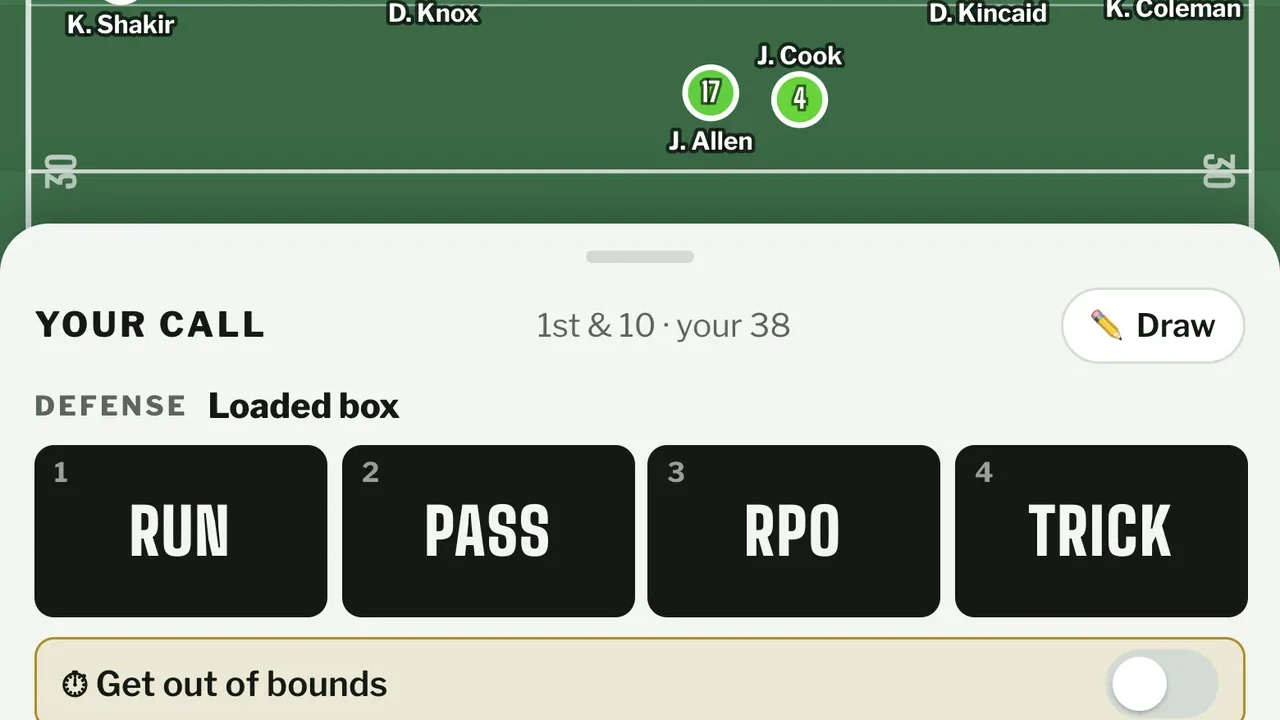
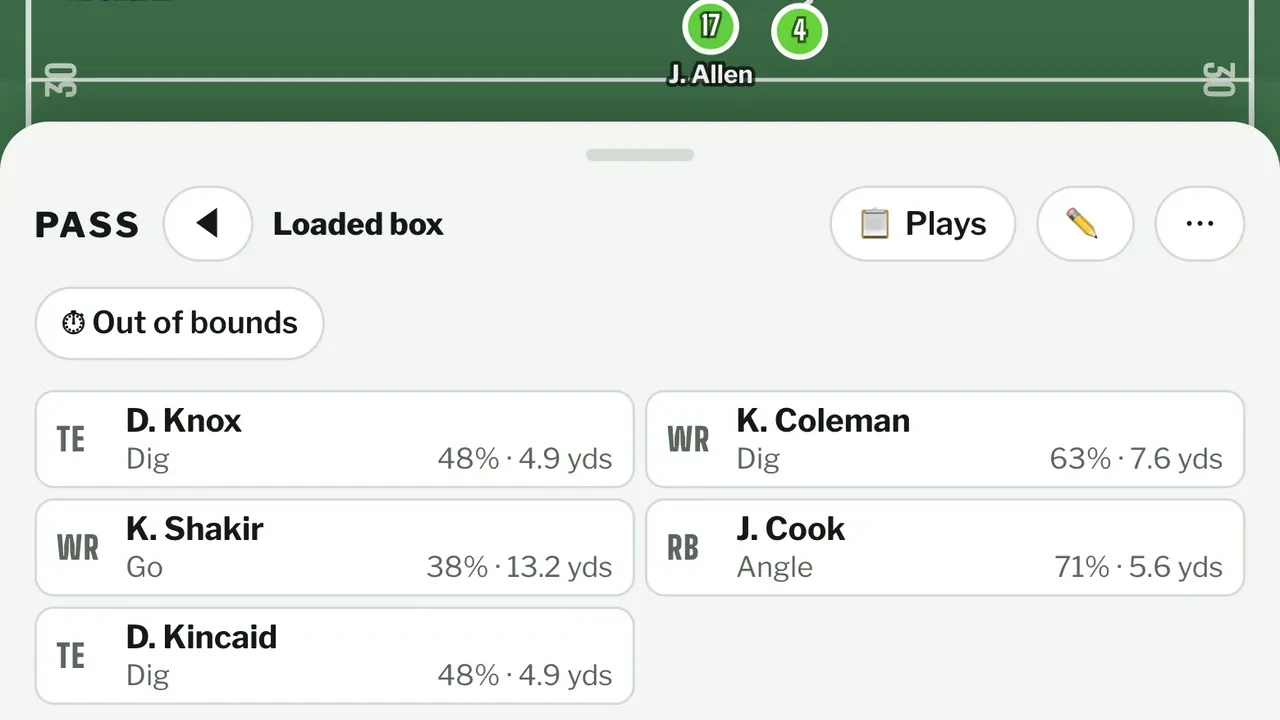
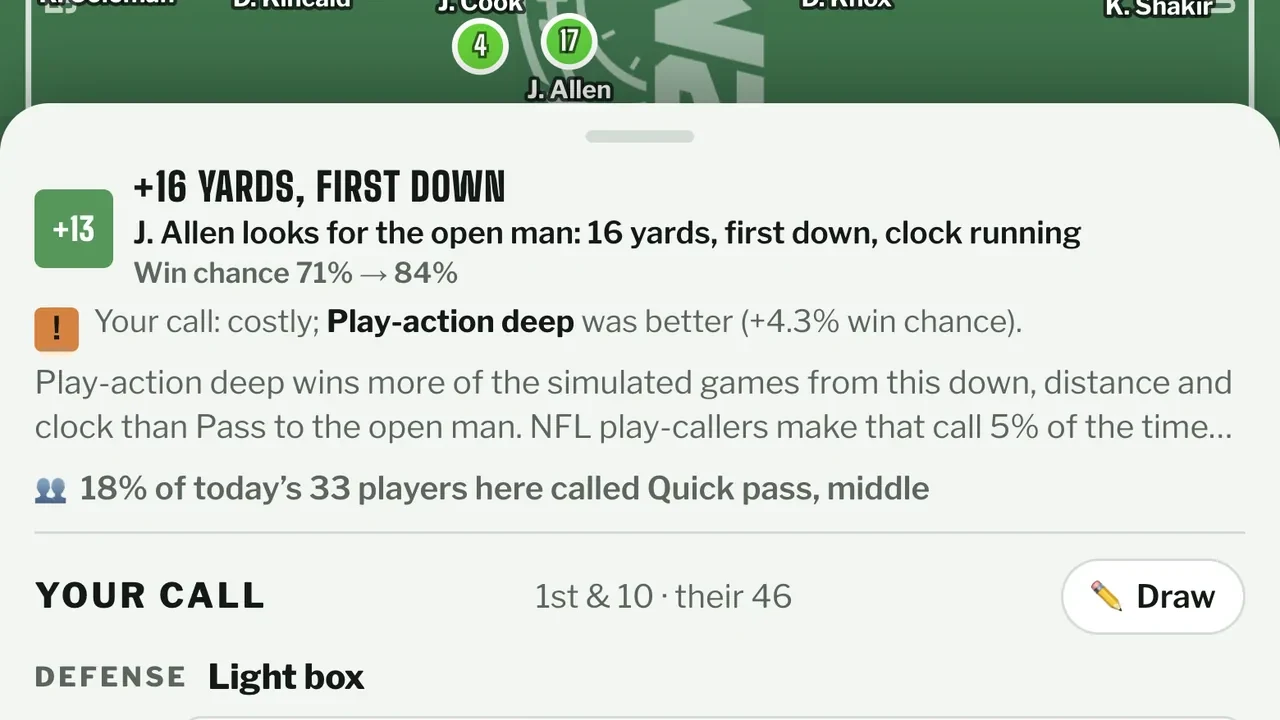
Where the Weight of a Call Comes From
If the grade says how good a call was, the situation decides how much it was worth in the first place. With two minutes left and three timeouts, a failed deep shot costs almost nothing. With forty seconds and no timeouts, the same call can end the game. The clock is a resource you spend on purpose: no-huddle, huddle and milk-it tempos move roughly 17, 34 and 38 seconds, and an incompletion stops the clock in a way a run does not.
Personnel and formation tilt the odds before you call anything. A light box, a stacked box and a blitz look each punish a different family of plays, and the pre-snap read tells you which one is in front of you. The ratings above each player's head are positional percentiles for that week rather than invented attributes, so the mismatch you are reading is one that existed on the field.
None of it is reflex. The weight you feel comes from information you did not use, which is a strange thing for a browser game to ask of a player who arrived expecting a throttle.
What a Bad Call Costs in Each Mode
Daily is the one that stings. One situation a day, identical for everyone, ending in a percentile against 6,000 simulated coaches whose habits follow real play-calling. A league-average set of calls lands near 50, and winning the game is worth roughly 15 to 20 points on the same calls, which tells you how much of the score is decision quality and how much is the bounce of a football.
Survivor strings random fourth quarters together and ends the run at the first loss, so one red grade can be the last thing you do that day. Versus is a one-on-one under college overtime rules from the opponent's 25 with no clock, thirty seconds per call, and two timeouts in a row counted as a loss. Pro is a single $4.99 purchase that adds historic drives, past dailies and a tool for drawing your own routes.
The modes differ in what they punish, which is the reason to play more than one. Daily punishes carelessness across a long drive, Survivor punishes a single bad read, and Versus punishes being slow. Pick the one whose punishment you can live with.
Two Builds Share the Name, and Only One Is Embeddable
There are two live builds called 2 Minute Drill and they are not the same game. The one on this page is nfl2mindrill.com: 27 calls, about 740 situations, Daily, Survivor, Versus and Pro, launched on 12 October 2026. The other sits at 2mindrill.online with 19 calls, 1,875 situations, a practice mode and a launch date of 20 October 2026 written into its own data.
They share a naming scheme and a large slice of the same situation records, but not the interface or the modes. For a player the practical difference is the size of the call sheet and the length of the daily ladder. There is a technical difference too: 2mindrill.online refuses to be framed by any other page, so the build you can actually play inside a browser window here is the 27-call one.
That detail is worth knowing before you compare notes with someone. Two players can spend the same evening on two games with the same name and disagree about how many plays existed.
2 Min Drill FAQ
Is 2 Min Drill free?
Daily, Survivor and Versus are free, with no download and no account. Pro is a one-off $4.99 purchase that unlocks historic drives, past dailies and a route-drawing tool, and the free modes stay playable without it.
What are the 2 Min Drill controls?
Click or tap the family, the call, the target and then Snap. Number keys 1 to 9 hit the numbered buttons, Space skips the snap animation, and Tab with Enter moves through the interface. There are no movement keys.
How is my call graded?
The model simulates the rest of the game from that spot for every option, then compares your choice with the best one. Green is the best call or within half a point, yellow is two points, orange five, and red is worse. The result of the play does not change the colour.
How long does one drive take?
There is no fixed length. A drive lasts as many snaps as the situation needs, and Space skips the animation, so most of your time is thinking rather than watching.
Can I play it on a phone?
Yes. The page detects a touch screen and switches layout, and the build can be installed to a home screen. The first load pulls several megabytes of play and engine data, so mobile data is the weak point rather than the controls.
Is it official NFL content?
No. The footer states it is an independent fan project with no affiliation to the league, its teams or the players' association. Situations and ratings come from nflverse and FTN charting data under a CC BY-SA 4.0 licence.
Driving Games Here That Ask for One Good Read
If what you liked was reading a situation and committing before the moment passed, these are the closest things on this site.


